8-Track to A.I.
A GenX-er shares perspective on life, technology, and holding on to humanity in an increasingly digital world.

Do you even know what an 8-Track Is?
If I’m honest, I barely do either. My mom had one in her Oldsmobile 88 diesel sedan she shuttled us around in as kids. I think the only cartridge we had was the one that came with the car.
I bet I could Google that…Yep,—Jesus this is it.
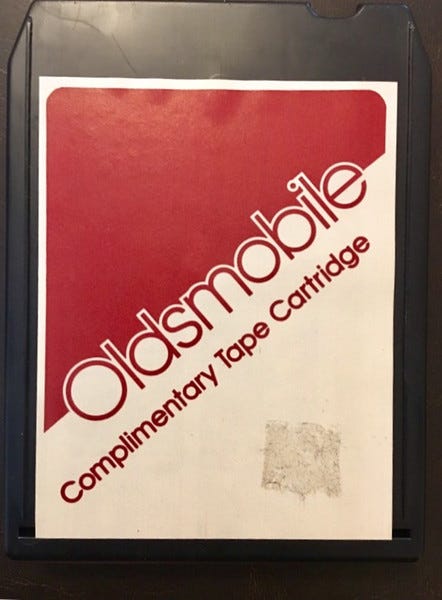
Looking at that song list might give you a hint at how weird things were back then. Listening to it definitely will.
I mean, what do Toto, Willie Nelson, and Kenny Loggins have in common? My youth, I guess.
The 8-Track was cutting edge for its time. Before that you had to keep records in a crate and worry about scratching or breaking them. Despite all their analog glory, they don’t travel well.
My people were masters of the cassette tape, then the mix tape, and eventually the CD. We’d buy and listen to a whole album at one sitting.
I know.
1976
Bicentennial babies, they called us. I was born 200 years after the American experiment began. After the “Great” war, and just after ‘Nam—perhaps the first indication that the USA might not always be on the righteous side of things.
We got our own special Quarter. Or at least I always thought they were for us, and I saved them in a jug for years as a kid.
We watched the Berlin Wall come down. We were of draft age when 9/11 happened, and witnessed the chaos reserved for elsewhere coming home to roost.
Mine is the generation in the shadow of the Boomers—who inherited perhaps the wealthiest and easiest time in history from their hard-ass parents, then spent their twenties tuning in and dropping out before spending their thirties watching Wall Street and Miami Vice in suburbia.
We inherited their skepticism without their optimism.
We grew up with 8-bit video games, phones on the wall, and being left alone while our parents finished the work day.
By the time we came of age, we weren’t having any of it. Our music was grungy. Our clothes were baggy. And “the American Dream™” didn’t have the same allure.
We just didn’t know what to make of any of it.
The Promise
(Great song, look it up kids. ok, fine. Here:)
Oh wait, you probably know this one cause our man Sturgill covered it a few years back:
He’s a Gen X-er too.
I’m talking about the promise less spoken but more assumed since the industrial age: that technology is the solution to all our problems and will deliver us to utopia.
You know, Star Trek and all that.
I’m starting to think that new tech isn’t always progress. Or more precisely, that with every step forward comes new potential pitfalls.
I’m starting to think new tech isn’t always progress. Or more precisely, **that with every step forward comes new potential pitfalls.**
We often forget that these powerful technologies are really just *tools*—tools we’d do well to approach with a bit of caution. Maybe the Amish are on to something.
This isn’t a new sentiment, I get that. “TV is gonna rot our brains!” after all. “Rock n Roll is the Devil’s music!” That’s what they told us when we were kids.
If Granny only knew what was coming with OnlyFans and social media. She’s rolling in her grave somewhere.
Now don’t get it twisted. I’m just as caught up as anybody in the promise of a techno-fueled tomorrow. I went to Epcot Center as a kid. I rode the monorail and watched The Jetsons. I work in high tech. I try out the latest gadgets. I spend 60+ hours a week looking at screens.
I’m still waiting for my flying car.
But I also get my hands dirty. I walk on the earth and sleep under the stars. I build stuff—for fun.
I’ve seen a lot: infinite hype cycles, the slow-motion collapse of… well, everything, and enough lies to fill an encyclopedia. Maybe it’s just the jaded Gen X-er in me, but I can’t help wondering—in our relentless race to the future, have we lost something essential?
Artificial Intelligence
I was a skeptic. Just another hype cycle, I figured. Then I tried it.
I made some weird images. I had it write jokes. Cute toy.
Then I asked it to help with something I actually do for work—something complex—and it nailed it. Not perfectly, but close enough to feel like cheating. I had superpowers.
A week later, I asked about something I actually know deeply. It was confident and wrong. I caught it, but I wondered: how many times had I *not* caught it?
That’s when the ground shifted.
I really do want to believe we’ll thread the needle and that this AI stuff will lead us somewhere good. But I have my flannel-clad doubts.
New technology is always disruptive. This is the first piece of tech coming for the noosphere—the realm of the mind we humans have always held total dominance over.
High-tech Luddite
Every generation has their pre-millennium tension, and I’m sure there’s some of that in what I’m saying. People really do freak out at big year changes—Y2K, anyone?
But I think this is different.
The pace and nature of the advance is approaching a Kurzweilian maximum—meaning straight up.
TV might have rotted our brains. But the thing we’re building now has the potential to render the species irrelevant. That’s not hyperbole. Serious people are saying it. I’ve read the papers. I’ve talked to the engineers.
I feel like I have a foot in both worlds: one where we were humans first and had machines to help us out, and this new one where the machines might not need us at all.
Maybe it’s the rising swell of these developments. The unknown implications for everything we thought we knew about the order of things. A set-wave about to crash.
Or maybe I’m just getting old.
I contain multitudes
Working in tech my whole career has kept me on that leading edge, surrounded by brilliant net-natives—kids who grew up always having the internet.
I love them. I’m constantly amazed at their minds. I like to think I can hang.
I also want to help them if I can.
They don’t know what they don’t know. And that weird primitive world I come from is all but gone.
Maybe we can hold on to some of the good stuff together.
Do I contradict myself?
Very well then I contradict myself,
(I am large, I contain multitudes.)
I’m going to start sharing my perspective.
You’ll find me musing on everything from philosophy to parenting to 3D printing—through this lens unique to folks from my generation.
How do we navigate this exponential rate of change? How do we hold on to what’s essential about being human while leveraging these increasingly powerful tools? What does a post-industrial, post-informational society even look like?
I think I have an interesting take.